Volcano Live
volcanolive.com
Auckland Volcanic Field | Dr John Seach
Last updated: January 2026

North Island, New Zealand
36.90 S, 174.87 E
highest elevation 260 m
Monogenetic volcanic field
Auckland Volcanic Field consists of 49 small basaltic volcanoes covering an area 360 sq km, underlying the city of Auckland. The volcano has been active for 140,000 years, and has produced 7 cubic km of eruption products.
The Auckland volcanic field covers an elliptical area of diameters 29 km x 16.5 km. The volcano is located 400 km west of the tectonic plate boundary through New Zealand.
Eruptions have ranged from phreatomagmatic (forming maars and tuff rings) to magmatic (producing lava flows and scoria cones). Some vents have displayed more than one eruption style. Each eruption has lasted for no more than 10 years, but occasionally eruptions have lasted for 100 years.
The most recent eruption was Rangitoto, about 600 years ago. Rangitoto Island is part of the Hauraki Gulf Marine Park, 3 km offshore from Auckland. Eruptions from the island account for 59% of the eruption volume at Auckland.
Eruption frequency has been variable over the history of the volcano, but eruption magnitude has increased with time. The longest lava flow extends for 10 km and a maximum thickness of 60 m. Total surface area of lava flows is 75 sq km. Lava on Rangitoto Island covers 23 sq km.
Historically there has been a low level of seismicity at the volcano. It is anticipated that future eruptions at the volcano would be preceded by 14-90 days of seismic activity, based on experience with similar volcanoes elsewhere.
Warning: Future eruption could occur anywhere in the field with short warning (weeks). Lava flows, ashfall, and pyroclastic surges threaten urban areas, infrastructure, and population. Evacuation planning essential.
Geology and Volcanology
Auckland is a monogenetic basaltic volcanic field with ~50 small centres (maars, tuff rings, scoria cones). Intraplate setting away from plate boundary. Eruptions driven by mantle plume or rift extension. Short-lived vents with variable styles. Monitored by GeoNet; low current risk but high impact potential due to overlying city.
Current Activity (January 2026)
Auckland Volcanic Field remains dormant with no eruptive activity for ~600 years. Low seismicity and stable deformation. No surface manifestations. Monitoring by GeoNet ongoing; capable of sudden new vent formation.
Auckland volcanic field photos by Dr John Seach
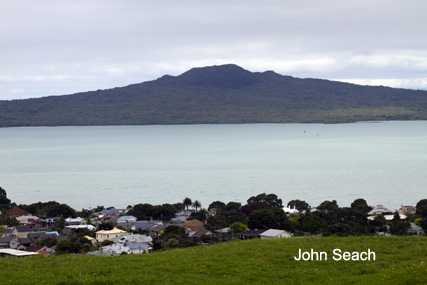
Rangitoto Island. Auckland's youngest volcano.
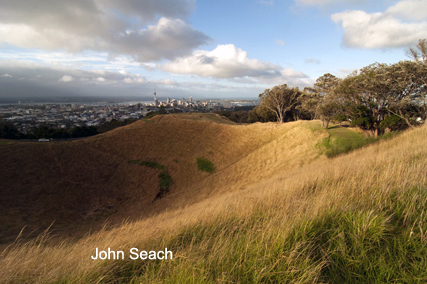
Mt Eden - crater close to Auckland CBD.
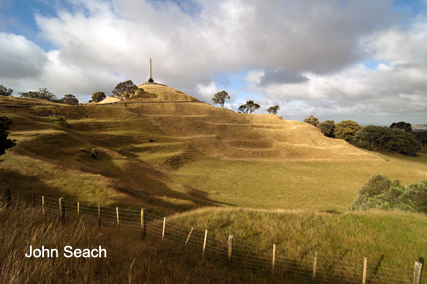
One Tree Hill, Auckland
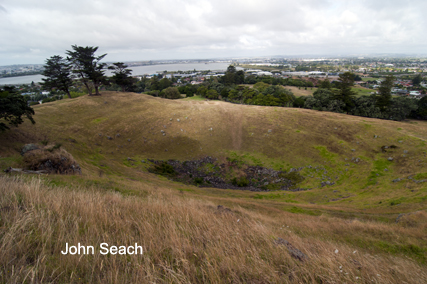
Mt Mangere, Auckland
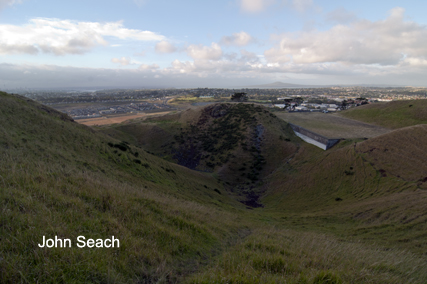
Mt Wellington, Auckland
2013 Earthquakes
Two earthquakes (mag 3.9 and 3.1) hit 5 km east of Rangitoto Island on 17th March 2013.
Further reading
Linnell, T. et al., 2016. Long-lived shield volcanism within a monogenetic basaltic field: the conundrum of Rangitoto volcano, New Zealand. Bulletin of Volcanology, 128(7-8), pp.1160-1172.
Rout, D.J. et al., 1993. Geophysical evidence for temporal and structural relationships within the monogenetic basalt volcanoes of the Auckland volcanic field, northern New Zealand. Journal of Volcanology and Geothermal Research, 57(1-2), pp.71-83.
Auckland Volcanic Field Eruptions
~600 years ago (Rangitoto Island)