(Eyjafjoll)
Iceland
63.63 N, 19.62 W
summit elevation 1666 m
stratovolcano
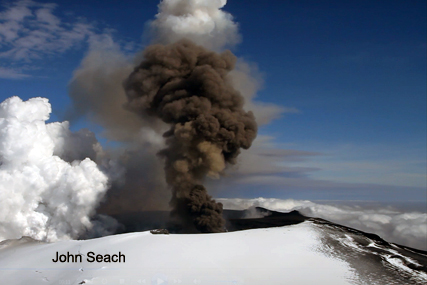
World's first summit eruption video of Eyjafjallajokull volcano taken by John Seach...
Eyjafjallajokull volcano is located in southern Iceland under Eyjafjallajökull icecap. The southern end of the volcano was once part of the Atlantic coastline. The sea level has retreated some 5 km, leaving behind sheer cliffs with and many waterfalls such as Skógafoss.
First Expedition to the summit of Eyjafjallajokull volcano, April 2010
The first summit expedition to Eyjafjallajokull volcano, Iceland after the March eruption was made by John Seach in April 2010. While on the summit John observed two active vents inside the main crater. The southern vent was showing almost continuous Strombolian activity, and the northern vent showed phreatomagmatic eruptions. Intensified activity occurred under the Gigjokull Glacier on 1st May.

John Seach at summit of Eyjafjallajokull volcano, April 2010.
John's expedition was the first to reach the summit after the 2010 eruption.

Summit eruption of Eyjafjallajokull volcano, Iceland - John Seach

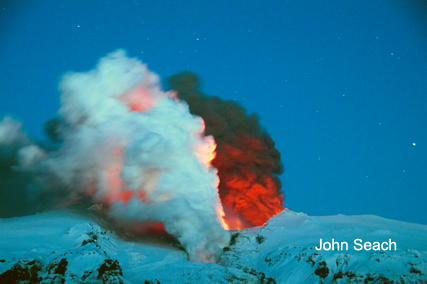
Eyjafjallajokull eruption 2010 - John Seach

Workers cleaning ashfall from farm near Eyjafjallajokull volcano - John Seach
Eyjafjallajokull volcano contains a 2.5 km wide caldera.
Eyjafjallajokull has been much less active than neighboring volcanoes. Since 1600's there have only been three eruptions at Eyjafjallajokull, while nearby Katla had 20 eruptions.
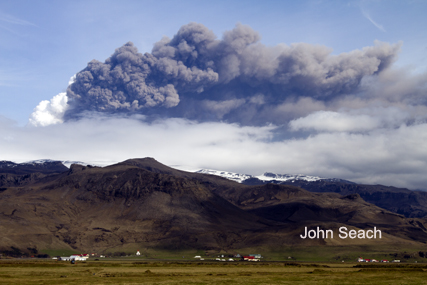
The first 2010 eruption occurred at Fimmvörđuháls.
2010 Eruption
An earthquake swarm began under Eyjafjallajokull volcano in January 2010. There was a 40 mm inflation of the volcano. At the beginning of March 2010 over 3000 earthquakes were measured in a 24 hour period, with a maximum at magnitude 3.1.
An eruption began near the Eyjafjallajökull glacier on 21st March 2010. Locals reported lava fountaining and a lava flow from the glacier. Residents were evacuated. The eruption was limited to an area with little ice, so the threat of a flood was reduced.
16th May 2010 Update
Ash emissions from Eyjafjallajokull volcano in Iceland reached a maximum height of 27,000 ft on 15th May. An earthquake swarm was recorded beneath the volcano between 23:54 hr (14th May) and 02:45 (15th May). Over 30 earthquakes less than magnitude 2 were recorded at a depth of 30 km. Lightning continues to be recorded in the eruption plume from Eyjafjallajokull volcano with a rate of about 30 strikes per day.
9th May 2010 Update
Ash emission from Eyjafjallajokull volcano forced the temporary closure of schools in southern Iceland. The eruption is still in the explosive phase. Ashfall was reported in Vik, southern Iceland on 8th May. Very little steam was observed at Gígjökull glacier on the northern side of the volcano. About 5000 flights were disrupted on Friday as ash drifted towards Europe.
22nd April Update
Eruptions have decreased at Eyjafjallajokull volcano in Iceland. Present magma eruption rate is about 75 tonnes/second which is about 10% of the 72-hour long maximum phase. Phreatomatic eruptions continue from the northern crater, and a plume is reaching an altitude of 3 km. About 100 million cubic meters of material has been erupted so far. Ash fall is 30 m deep near the crater. There have been no changes in crater size at Eyjafjallajokull volcano since 19th April.
21st April Update
Ash emissions from Eyjafjallajokull volcano in Iceland are decreasing as parts of the glacier have melted, allowing lava to reach the surface without magma-water interaction. This will be good news for travelers because it will help clear skies over Europe. However volcanic eruptions are unpredictable, and activity can change without warning. Some airlines are not taking any new bookings on flights to Europe until the middle of May, as the backlog of travelers need to be cleared first.
20th April update
Flights have resumed to airports in Scotland and northern England, and airports are expected to reopen in France and Germany later in the day. Eruptions continue from Eyjafjallajokull volcano in Iceland, with ash emissions to 4500 m altitude.
19th April Update
More than 63,000 flights have been cancelled due to the eruption of Eyjafjallajokull volcano in Iceland. Ash is approaching the coast of Canada near Newfoundland, and is expected to reach the coast at about 1 pm. Eruptions are continuing at the volcano.
18th April update
Ash emissions are continuing from Eyjafjallajokull volcano in Iceland. Winds are blowing the ash over Europe, causing flights to remain grounded. All flights to and from Britain have been cancelled until at least 7pm today. Ashfall has been reported in Britain. Five million travelers are stranded, waiting for flights to resume. Some may be waiting for more than a week to find available seats. If flight disruptions continue into this week there will be a shortage of some food products in Britain, which normally come in by air from east Asia and Africa. The grounding of flights has already cost the British economy about Ł1 billion, with Ł230m losses for every day of further disruption. The initial eruption of Eyjafjallajokull volcano last month was basalt, while the new eruption under the glacier last week involved andesite.
17th April Update
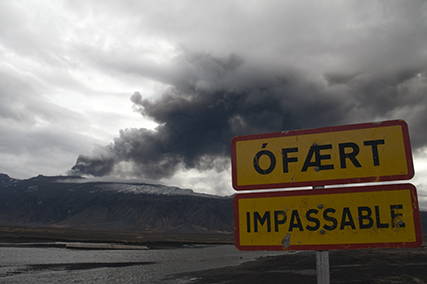
A significant eruption was continuing at Eyjafjallajokull volcano in Iceland. Ash emissions were reaching 28,000 ft. On 16th April there was a glacial outburst, and water level in Markarfljót rose by 50 centimeters at 6pm. There was another glacial outburst earlier in the day at Gígjökull glacial tongue. More glacial bursts are expected as the eruption continues. Roads are closed by Fljótsdalur, the old Markarfljót bridge on highway number 1, and by the villages of Vík and Kirkjubaejarklaustur.
16th April 2010 update
A significant eruption is continuing at Eyjafjallajokull volcano in Iceland. Ash emissions are reaching a height of 33,000 ft. Emissions from the volcano are drifting across the UK, and are heading for central and eastern Europe. Ash has already reached as far south as Italy. All flights in the UK have were grounded due to ash emission Eyjafjallajokull volcano in Iceland. This is the first time that British airspace has been totally closed. The eruption resulted in the cancellation of 17,000 flights, worldwide. Travelers were stranded in Australia, USA, and Europe as connecting flights to Europe were affected.
14th April 2010 update
A new eruption occurred on 14th April 2010 at Eyjafjallajokull volcano, Iceland. The eruption was accompanied by earthquakes and has opened up a new vent. Glacial flooding has occurred on both sides of Gígjökull. Flow in the Markarfljót river increased significantly and the water level has risen by 84 centimeters. Magma is melting its way through the icecap producing a circular ice free area by the summit 200 meters in diameter. Iceland’s highway No. 1, was closed between Skógar and the crossroads to Gunnarsholt east of Hella. About 45 people in Langidalur valley north of the Eyjafjallajökull glacier were isolated by the eruption, and 800 people were evacuated.
2010, 1821-23, 1612