Volcano Live
volcanolive.com
Mt Melbourne Volcano | John Seach

Victoria Land, Antarctica
74.35 S, 164.70 E
summit elevation 2732 m
Stratovolcano
Mt Melbourne is the only active volcano on the mainland of Antarctica. The volcano is in fumarolic stage. These photos were taken by John Seach on an overflight in 1998.
Observations of the volcano in 1972 and 1983 showed 3 areas of steaming ground, and fumarolic ice towers.
Photos of Mt Melbourne volcano by John Seach
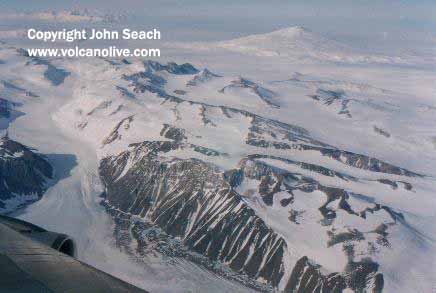
Mt Melbourne, 2733 m, stands isolated near the coast of
Terra Nova Bay.
Mount Melbourne in the top right of the photo. In foreground are Shepard Cliff and Priestley Glacier.

Mt Melbourne is visible in the distance. Some areas on the north flank are devoid of snow.
Previous expeditions have found active fumaroles.

Trans Antarctic mountains. The air is so clean that the horizon can be seen 400 km away!
The classic back-lit yellow horizon is visible. These craggy peaks are in sharp contrast to the
smooth stratovolcano shape of Mt Melbourne.
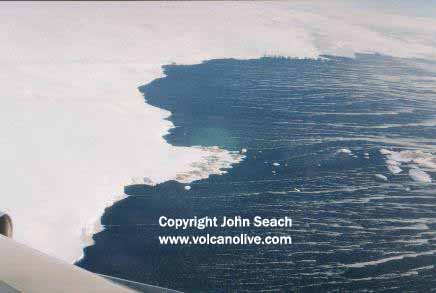 These Katabatic winds at Cape Denison, Commonwealth Bay, are the strongest in the world.
The 300 km/hr winds can be seen driving snow off the frozen ocean. On this day the sea was
frozen 800 km further north of this point. The winds are the result of cold air falling
off the Antarctic Plateau to the coast.
These Katabatic winds at Cape Denison, Commonwealth Bay, are the strongest in the world.
The 300 km/hr winds can be seen driving snow off the frozen ocean. On this day the sea was
frozen 800 km further north of this point. The winds are the result of cold air falling
off the Antarctic Plateau to the coast.
The moss Compylopus pyriformis occurs on two small areas of steam-warmed snow-free ground near its summit.
Shield Nunatak is a flat-topped complex of eruption centers, rising to 300 m above present day sea level within the south-eastern part of the Mt. Melbourne volcano. An estimated total volume of 0.15 cubic km of alkali-basaltic magma was erupted at Shield Nunatak.
Mt. Melbourne volcanic field consists of about 60 exposed, ice covered, eruption centers which surround Mt. Melbourne stratovolcano.
Further reading
Del Carlo, P., Di Roberto, A., Re, G. et al. Historical explosive activity of Mount Melbourne Volcanic Field (Antarctica) revealed by englacial tephra deposits. Bull Volcanol 85, 39 (2023)
Wrner, G. and Viereck, L., 1987. Subglacial to emergent volcanism at Shield Nunatak, Mt. Melbourne volcanic field, Antarctica.Polarforschung,57(1/2), pp.27-41.
Nathan, S. and Schulte, F.J., 1967. Recent thermal and volcanic activity on Mount Melbourne, northern Victoria Land, Antarctica.New Zealand journal of geology and geophysics,10(2), pp.422-430.
Mt Melbourne Volcano Eruptions
Currently only fumarolic activity.