Volcano Live
volcanolive.com
Vestmannaeyjar Volcanic System | Dr John Seach
Last updated: January 2026

Westman Islands, Iceland
63.43 N, 20.28 W
highest elevation 279 m (Heimaey)
Volcanic islands / submarine vents
Vestmannaeyjar Volcanic System is a group of islands off the south coast of Iceland. Two famous eruptions occurred at Surtsey in 1963-1967 and Heimaey in 1973.
Warning: Sudden submarine or island eruptions possible with explosive activity, ash plumes, and lava flows. Access to active areas restricted; boat tours require caution during unrest.
Geology and Volcanology
Vestmannaeyjar is a basaltic volcanic system in the East Volcanic Zone offshore extension. It features emergent islands (Heimaey largest) and submarine vents. Eruptions range from effusive to explosive (Surtsey submarine-to-emergent, Heimaey fissure). Monitored by Icelandic Meteorological Office (IMO) with seismicity and deformation data.
Current Activity (January 2026)
Vestmannaeyjar remains quiet with no eruptive activity since 1973. Low seismicity and stable deformation. Tourism to Heimaey popular. Monitoring by IMO ongoing; capable of sudden reactivation.
Vestmannaeyjar volcano photos by Dr John Seach

Heimaey, Iceland - Dr John Seach
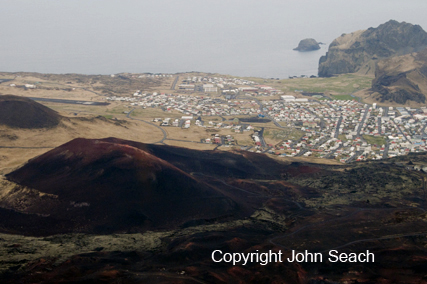
Heimaey volcano, Iceland - Dr John Seach

Airport on Heimaey Island
Surtsey
Surtsey is a volcanic island located off the southern coast of Iceland. It formed in 1963 and 1964 as a result of a submarine volcanic eruption. The eruption began on November 14, 1963 and continued for several years, creating a new island that reached the surface of the ocean.
The island is composed primarily of basaltic lava and tephra, with a total volume of about 0.25 cubic kilometers. The eruption was characterized by explosive activity and the formation of ash plumes and volcanic bombs. Surtsey is unique in that it provides a natural laboratory for the study of the colonization and succession of plant and animal life on a new volcanic island.
The island is protected as a nature reserve and is only open to scientists for research purposes. The volcanic activity at Surtsey ceased in 1967, and since then, the island has been gradually eroded by wave action. The island has been studied extensively by scientists and has provided valuable insights into the processes of island formation and ecosystem development.
The Surtsey eruption was a significant event in Iceland and it was the most recent volcanic island to form in the country. It has also been a valuable natural laboratory for studies of volcanic island ecology and geology.
Heimaey Island
Heimaey is a volcanic island located off the southern coast of Iceland. It is the largest of the Westman Islands and the only one that is inhabited. The island's main volcano, Eldfell, erupted in 1973, causing widespread damage to the town of Vestmannaeyjar and leading to the evacuation of the entire population.
The eruption began on January 23, 1973, with a fissure eruption on the eastern side of the island. The eruption was characterized by explosive activity, with ash plumes and lava fountains reaching heights of up to 1,500 meters. The eruption also produced a significant amount of lava, with flows covering about 5% of the island's area. The eruption caused widespread damage to the town of Vestmannaeyjar, with many buildings destroyed or covered in ash and volcanic material.
The entire population of the town was evacuated, and many residents did not return until the following year. Despite the extensive damage, the eruption also led to the formation of new land and the expansion of the island's area. The Heimaey eruption was one of the most significant volcanic events in Iceland in recent history, and it had a major impact on the island's residents and the local economy. The eruption also provided valuable insights into the processes of volcanic eruptions, such as the impact on a human population, the formation of new land and the ecological succession.
The 1973 Heimaey eruption in the Westmann Islands of Iceland, was similar in many ways to the 1970 Jan Mayen eruption.
Further reading
Mattsson, Hannes, and Armann Hoskuldsson. "Geology of the Heimaey volcanic centre, south Iceland: early evolution of a central volcano in a propagating rift?." Journal of Volcanology and Geothermal Research 127.1-2 (2003): 55-71.
Moore, James G. "Structure and eruptive mechanisms at Surtsey Volcano, Iceland." Geological Magazine 122.6 (1985): 649-661.
Vestmannaeyjar Eruptions
1973 (Heimaey), 1963-1967 (Surtsey), 1896 (near Hellisey), 1637-1638 (near Heimaey?). Older eruptions are not accurately dated.